Showing posts with label Week6. Show all posts

Tuesday, February 13, 2018

Week 6: Blog Post 5 - Relational Database Theory

Relational Database Theory


Definition

A relational database (RDB) is defined as a collection of multiple data sets stored and organized as items in a set of formally described tables (rows & columns). This data can be accessed or reassembled in any customizable way at a later point in time. This neat piece of creation was invented by Edgar F. Codd at IBM 1970 [1]. RDB runs on Structured Query Language (SQL), an application that provides a user-friendly programming interface for database interaction. [2] 


Types of RDBs
In an RDB, data is stored in a tabular format with rows and columns. A row represents a data instance and a column represents a column. One or more data that is stored relates to one or more data records to form functional dependencies. There are four types of dependencies:


  • One to One: One table record relates to another record in another table.
  • One to Many: One table record relates to many records in another table.
  • Many to One: More than one table record relates to another table record.

  • Many to Many: More than one table record relates to more than one record in another table. [2]
Function

The main capabilities of an RDB is its ability to communicate and relate one data instance stored in any row, any column, any table and any data set to another data instance in a likewise manner. The basic database operations are select, project and join. "Select" retrieves data, "project" identifies data characteristics and "join" combines relations of data instances.[2]

Other advantages include scalability and data security. It is basically a useful tool similar to Microsoft Excel, except instead of having computational power, it only stores data but can be store an enormous amount of data/information. Data security capabilities provide certain users access to all datasets while giving the option of preventing some users to access only certain databases. 

[1] http://searchsqlserver.techtarget.com/definition/relational-database

[2] https://www.techopedia.com/definition/1234/relational-database-rdb


Comments:

Mark:

I read your article as a way to compare the content we found since we have the same topic. Essentially, we cover the same content such as keywords in the definition of a database, the importance of relations. Great job on including the figures as it highlights and exemplifies the difference between tables with relations and one without.

Tyler:

My blog post covered the topic of Relational Database Theory which is basically the body of data storing. But while reading I saw that SQL is the main "language" used when talking to these databases we created. And your article reinforced my initially understanding of what SQL does. The highlight of your article to me is that SQL is still used as the main language used to talk to databases which I would assume technology nowadays would have probably have replaced it. But I like your idea (more so a statement) that SQL is and should co-evolve with databases and its various types. Not just simple inventory tables but complex large scale data such as AutoCAD and Revit related data per family created.


Chris:

I agree that time is money and money is time in the world of construction. this DSM sounds like a pretty neat piece of technology that could potentially revolutionize future construction work. Hours vs Months is quite a feat to achieve but what I would be worried is the socio and economical problems that will arise when "machines start stealing human's jobs".


Gibson B5 - Databases in Construction Firms

My article discussed how Massachusetts Institute of Technology (MIT) have developed a new system that can replace humans and actually outscored 615 of 906 human teams at the last three science competitions. The first prototype seemed to work very well after performing better than more than half of human teams. This device is called "Data Science Machine" (DSM).  The DSM was able to produce answers to these science problems with 87%-96% accuracy, however, it took human teams of scientist all around the world months compared to the 2-12 hours the machine took. The massive amount of data that this device can run through can be crucial to the time-consuming design of a structure. By using different tables and charts of data in the DSM, it can help project cost and time. These are two key factors that are lacking in the construction world.

With this type of precision and accuracy, simple design calculations will not need to be redone or take up any time excess time allowing engineers to quickly check its work and move on to other ongoing projects. In the construction world time is money and this device can be greatly taken advantage of in major construction firms to increase overall efficiency
.
Response 1: Jacob Wahbeh
Jacob, after reading your post I better understand how databases and BIM work together. These incorporated BIM databases would have made my second co-op so much easier and available to access at any time.

Response 2: Dee Dee Strohl
Dee Dee, I really enjoyed your post and your definition of what an actual database is. I struggle with the types of databases and complexity of them. I appreciate how you broke a database down from different points of views.

Response 3:Shuyuan Zhang
Shuyuan, I like your definition of what a database is to you in your own words. Again this and the previously read post have given me a strong idea of what a database is and how exactly it can work. Your co-op experience is pretty interesting as I was on the other side of the design team (structural), so reading your techniques used in HVAC design helped me realize the big picture of how it all goes together.

Source:
https://scitechdaily.com/data-science-machine-replaces-human-intuition-with-algorithms/


Dee Dee Strohl - Blog 5


Uses of databases in design offices

What is a database?
A database is a computerized system that stores information that can be easily searched and selected. It is a collection of records that contain one or more fields (pieces of data) about some entity (object). This can be used in many applications; like libraries keeping track of available and checked out books, or a company who’s stored all employee information. There are a few types of databases that can be used: flat, hierarchical, network, and relational. Though Excel can and is used for a plenty of projects in design offices (and beyond), using a database is more capable with respect to large, complex projects that contain a lot of data or pieces. Databases are also attractive because several people can access and edit information at the same time.
From a design office perspective:
From an architectural or engineering firm perspective, using a database could be helpful in several applications. A database could be created to keep all client information and the projects associated with them. From working in an engineering firm, I’ve seen that different clients have specific requirements for building design and construction. Having a database to contain all the client information and specifications would be helpful. Especially because you can search for distinct words/requirements in the database easily. The database, and thus the information, can be accessed remotely and files are easily backed up to prevent losing work and edits.
From an owner perspective:
With databases, it’s easier for owners to share information with design firms and track progress. It makes finding documentation on both ends easier. Besides having access to a database for the design process, owners could create a database to use once the building is construction and in use. Information about the performance of the building systems, building automation, or life cycle could be track by looking at past and present data.
From a general perspective:
Because databases are becoming more and more used, the sharing of information has gotten easier. Different firms and people can share their projects or technologies with the world through them, making processes easier and more efficient. Even throughout college, databases have made it easier to research for classes and papers. This is particularly seen from the Drexel Libraries system, which allows you to search thousands of articles and journals with just a few keywords. It can also be helpful from a marketing perspective because everything is easily accessible.

Sources:
 “Architectural File Management Systems and Database,” Human Service Solutions. Accessed 2/11/18. https://www.hswsolutions.com/work/case-studies/architecture-file-management-database/
“Database Definition,” The Linux Information Project. Accessed 2/11/18. http://www.linfo.org/database.html
“How to Better Manage Your Project Data,” Archsmarter. Accessed 2/11/18. http://archsmarter.com/manage-project-data/

COMMENTS:
Isaac Quelly:
It’s awesome that you got to look at the GSI project and database in its early stages. I see why it’s important for every step of the design and build process to be tracked and added to the database and how it could be troublesome if changes are made without the correct procedure. Do you think the PWD has done anything to keep this issue from occurring in projects? Do you think the implementation of this technology will continue? I know when I worked at the city people were hesitant to take on new procedures.
Luciana Tangari:
Like you, I know nothing about object oriented databases (I honestly barely understand the types of databases as a whole). The analogy you added to your post was very helpful in gaining a better understanding of OODMS and relational databases. It’s interesting that OODMS can handle such complex data but makes it easier to access. I’m still not completely sure I understand OODMS, but your post helped me at least gain a bit of knowledge on the topic.
Dung Tran:
Thanks for giving me an understanding of what a relational database is. I ready in Luciana’s post about OODMS so it was nice to read about the other side of the coin. It’s interesting that in this type of database tables can be defined with constraints or algorithms but also don’t have to be. The images you included also made your (and Darwen’s) explanation easier to understand.

Amisial B-6 Uses of Database in Design Offices

Amisial B-6 Uses of Database in Design Offices
Per my belief, I think database is an indispensable tool for any successful companies and offices. Since they could be used for a variety of task in businesses and offices, they became a daily tool that most employees use for accomplishing projects. According to Herzing College:
“Databases are used to structurally organize and capture large quantities of data by inputting, storing, retrieving and managing information. While we commonly think of databases to be online stores of information, a phone book or census also qualify as examples. In computer lingo, a database application is the program responsible for retrieving and storing this data. Offices these days generally function on a database management system, which provides an interface between the user and the database, and also catalogues data. Some of the more popular database management systems include Oracle, MySQL and Microsoft Access. Since there are a variety of DBMS’s available to choose from, each office may function using different software. For this reason, DBMS software will often come with an Open Database Connectivity driver, which allows different database systems to interact and share information.

For instance, Dropbox is a popular system of cloud storage like Google Drive, where users can maintain, share and access massive quantities of files on the internet. It itself acts as a huge database, where one can “drop” or sync images, documents, downloads into a private or shared account, for the intent of then being immediately accessible from any computer with an online connection. Rather than emailing the same files to ten different people, a database will receive the data and allow the other ten co-workers to view and download at their will. “


Reference: http://www.herzing.ca/blog/winnipeg/the-importance-of-database-applications-in-the-office/


Comments:
Isaac,
It was interesting that you have related functionality of database during construction with your past personal work experience. I can see why it would be a struggle to have a database that allows multiple incoming updates from several parties. I found myself genuinely interested in finding database with such capacity, but I can tell you during my time working for the city, I was able to access a database with which my team was able to update multiple projects concurrently.

Wicker,
Your writing about Structured Query Language (SQL) was enjoyable, and I agree with you by stating that SQL must evolved alongside with some design programs. In fact, as you understand the relationship between SQL and design program or database, it becomes more efficient for the user, and their both intended purposes are more reachable.

Sonny,
I like the way your information was presented about relational database theory (RDB). As someone who is a novice in RDBs; I could say that they are a primary tool for user-friendly type of database, and they are mostly used for database in which it is important to present the users information in the form of tables.

B5 - Object Oriented Database - Marino


Object-Oriented Database


Object-oriented database is a database management system that represents its information in the form of objects. Object oriented database, which is also known as object oriented database management system (OODBMS), similar to object oriented programming languages. It can allow the user to combine the features of relational model such as transaction, concurrency, recovery into object oriented database model. There are three different features of object oriented database such as polymorphism, inheritance, and encapsulation. Polymorphism is known as object oriented programing language. It has ability to process objects according to their data type or class. Inheritance is one of the features of OODBMS that can create a new object from an existing object including all the characteristics of the existing object. Encapsulation is called one of the principal concepts in object oriented programming (OOP). It binds and manipulate the data and functions together as one unit.

The benefits of object-oriented database are composite objects and relationships, class hierarchy, no query language, no impedance mismatch, no primary keys, and one data model. One of the greatest benefits of using an OODBMS is that the user can store many different types of objects in a large class where it can also hold many medium classes as well as many smaller classes or objects. Object oriented database delivers information in a form of class hierarchy, which presents the information that easy to understand without spending too much time to get to know the details. Another benefit of object oriented database is easy to use and it does not have primary key. The user also can store or manipulate the information without spending too much time to mapping tables to objects and back unlike the rational database management system.

The downsides of the object oriented database are schema changes, language dependence. In OODBMS it is difficult to modify, update, or create the schema after completing the database management system. Usually the user has to recompile the system when the user decides to make schema changes. Another disadvantage of OODBMS is selecting the language has to only come from specific language using a specific API which also known as application language independent. This can be very confusing for some users when they are not familiar with API language.


Source: 

"AN EXPLORATION OF." Why Arent You Using An Object Oriented Database Management System? Accessed February 13, 2018. http://www.25hoursaday.com/whyarentyouusinganoodbms.html.


Object Based Databases Tutorial. Accessed February 13, 2018. http://www.tutorialride.com/object-based-databases/object-based-databases-tutorial.htm.

Beal, Vangie. "Polymorphism." What is Polymorphism? Webopedia Definition. Accessed February 13, 2018. https://www.webopedia.com/TERM/P/polymorphism.html.

"OOP Concept for Beginners: What is Encapsulation." Stackify. December 01, 2017. Accessed February 13, 2018. https://stackify.com/oop-concept-for-beginners-what-is-encapsulation/.


Deutsch,

You did such a great job explaining Rational Database Theory! I like how first you explained the general theory about database and then you went into details explaining the concepts of Rational Database. When I was reading about object oriented database in few articles I also found some interesting information about Rational Database. One of the interesting concept of rational database that I found was the user can modify, update, or change any information that already put in the table. In object oriented database it is difficult for the user to make a change on the database once its management system is completed.

Thomas,

You explained the importance of the SQL very well. I took INFO 210 and this course was about SQL. The database program such as Oracle SQL was interesting to learn but it required a lot of attention in class and practice the program at home in order to master the program. I agree with you that SQL allow us to understand and access the database elements a lot easier compare to some other database program such as Codasyl database.  

Zac,

I felt like I had to make a comment on your post after I read the word “Primavera P6” in the first sentence of your second paragraph. I had experienced using Primavera P6 when I took one of the construction management courses. The course was really fun and it was interesting to use Primavera to make a work schedule of a construction project the fact that it’s not only easy to use to conduct a work schedule but it also shows the Critical path of the project. I personally would like to recommend you to learn about the program if you are interested in learning about scheduling database.


Monday, February 12, 2018

Jianfeng Xiao - Blog 5 - Use of Database in Design


From Wikipedia, it is clear to know that a database is an organized collection of data. In our life, data can be collected from everywhere: cellphone, sensors and digital tools, etc. Data can be use in a building’s whole life cycle, such as design, construction and maintenance phase. In this post, the importance of using database in designing process will be discussed.
In the article “How Big Data and VR in Architecture Will Greatly Improve Design”, it talks about the combined force of data and VR in design will advance the architectural practice. At the beginning, it provides an example of old time and current method of collecting data for designing. Harvard University hired Sasaki Associates to run a master-planning exercise. A question was being asked by Sasaki, “How do student get into campus”. For old method, college kids would be hired to sit out there to count. But for current method, a program was used to track the movement. The current method is much convenience. Through this survey, Sasaki team knew which way student prefer so that they could focus on these paths when designing the whole plan. In addition, the VR is also helpful in designing. Through running the simulation in virtual model using collected data, the designer can have a more accurate idea of what the site or building will be like when constructed. The VR allows designer to see if their design is appropriate or not. Through applying both database and VR for designing, designer will be able to design more effectively and more efficiently. If a designing firm can collect and organize all data from previous project, this will help designer to make better design decision.
Other than the plan designing, database can also be applying to ventilation design of an building by using sensors. In the article, “The world's most sustainable building is also the smartest”, sensors are used to measure every aspect of lighting, CO2 level and humidity. This will help to measure the air quality and wellness condition of building. Through analyzing these data, designer can know how to design more comfortable building.

Sources Cited:
BERNSTEIN, PHIL. “How Big Data and VR in Architecture Will Greatly Improve Design.” Redshift by AUTODESK, 21 Feb. 2017, www.autodesk.com/redshift/big-data-vr-in-architecture/.

PEAKE, ELEANOR. “The World's Most Sustainable Building Is Also the SmartestThe World's Most Sustainable Building Is Also the Smartest.” WIRED, www.wired.co.uk/article/this-is-the-worlds-smartest-building.


Lauren Kujawa Comments:
Lauren,
Your post about the importance of knowledge is interesting. I agree with you that construction firms should collect data from previous project to be able to apply them in future project. This will allow engineers to track projects and search for information they do not understand.
Carlos Hillinger Comments:
Carlos,
You did a great job explaining the object-oriented database and relational database. I have no idea of their difference until I read your post. The post I did is about the use of database of design. I think the database used in design is like object-oriented database that is more specific. I think you can discuss more about the areas where we use object-oriented database.
Mark Odorizzi Comments:
Mark,
You did a good job explaining the relational database theory. This is helpful for me to understand the concept of relational database. The tables clearly show what the relation and non-relation data looks like. This database seems to require the ability to code and program. I think you can also discuss what areas will this database can be applied.

Dung Tran - B5 - Relational Database Theory

Building Information Modeling also involves interacting with databases stored within the BIM software. On Week 4, our guest lecture from Whiting-Turner mentioned that properties data of all components ranged from structure to MEP that organizes the entire project were tabulated to design and modify building components better. This process can develop a massive data sets, which working with parameters are strongly required to manage. Relational databases would benefit the work by grouping these regulated parameters of building components together. But, what is the relational database in the world?

Database

Before discussing about the theory of relational database, we should summarize about the definition of database. Britannica defines database as "an organized collection of data or information for rapid search and retrieval by a computer" [1]. Database was introduced in mid-1960s to replace the tape-based storage system, at which computers could capable of processing data from direct-access storage such as floppy disks. At that moment, the information within database was stored in a tab delimited file, which is a horizontally long, and unorganized text file. In fact, it was challenging to neglect the unnecessary information in a large database while organizing reports for only a specific field. Therefore, relational database was introduced in 1970 in E.F. Codd's research paper "Relational Completeness of Data Base Sublanguages" as a standard on database construction.

Relational Database Theory

In his e-text "An Introduction to Relational Database Theory", Darwen defines relational database as a database set, which information was organized into a collection of relations in a tabular form [2]. Relation is a set of information that is associated with each other in algorithms, constraints, and more. Even though relation can be a table as stored in a tabular form, the term "table" is not completely defined relation. In fact, information stored in table can be free from any constraints or algorithms. Figure 1, on Darwen's e-text, demonstrates the comparison between tables that are either a relation or not. On the above table, raw information is organized in specific information such as Name, Student ID, and Course ID. For example, a student named "Anne", whose ID number is S1, registers for courses C1 and C2. 

Figure 1. Table depicting relational database (above), and not a relational database (below) [2]

According to Darwen, relational database theory includes the structure of a relation, relational algebra (mathematical theory that operates on relations), variables (set of parameters needed to operate the relational algebra), and constraints that regulate those associated variables [2]. A structure of a relation includes a table, whose columns represent its attribute, and rows represent tuples or the degree of the relation. Each row contains unique inputs, whose amount is respected to number of attributes (or degree). A complete dataset of the tuple is the combination of these unique inputs. A set of tuples generates a complete set of relation. Figure 2 represents the structure of a relation with their terms defined by E.F. Codd in his research paper. 

Figure 2. The anatomy of a relation [2]


Reference

[1] The Editors of Encyclopaedia Britannica. "Database" <https://www.britannica.com/technology/database>

[2] Darwen, Hugh (2010) An Introduction to Relational Database Theory, Bookboon.com.<https://dvikan.no/ntnu-studentserver/kompendier/an-introduction-to-relational-database-theory.pdf>

Comments

Milligan:

Kerry, this is a good introduction about relational database for someone who does not take INFO 210, or take a course in database management system. It looks like relational database has been a standard for constructing a data set for years, and most of our presentations involving with tabulated information uses relational database to present. Your examples are familiar about processing everyday data using relational database, which reduces the abstraction of theoretical discussion. Great work!

DiGiovanni

Brad, I am working on BIM project for this class which recreates a glass house built 80 years ago as a Revit model. It would be great if a general database is available for the building so that I do not have to skim through 20ish technical drawings to look for material components. Revit is also a great help by storing these information of a respective component. You are a right to mention about the importance of historical data of previous projects for design firms. It is essential for any design firms to be competitive by keeping records for maintenance, and case studies. In short, I believe 'Glass House' did not become a trend based on the data report about its vulnerability with outside environment / weather.

Liu:

Xiaoyu, I have struggles on my blog post about relational databases as well, and I hope we could be covered after the end of lectures on Tuesday. Your post is very informative about the definition object-oriented databases which is distinct from a tabular-based databases such as relational database. I believe an example of object-oriented databases is material properties stored in a respective BIM component, as all of its attributes is under a large umbrella. It is also great by controlling permanent and temporary data, that is how different elements in a same Revit family can be created.  

Object Oriented Databases - Hillinger

Carlos Hillinger -AE410 - B5

Object Oriented Databases

     I recently enrolled in a Database class required for my Intelligent Building Concentration, and it has completely changed the way I think and approach a database. I have learned how to develop Energy Diagrams using Chen notation and how to translate them into relational schema using three methods that our professor (Dr. Frein) has created for us. I will start working with SQL next week, which would have been helpful to complete this week's assignment. Without getting too much into detail, I want to share my thoughts on databases before writing about Object Oriented Databases.

     Databases are basically collections of data organized in a structured or hierarchical way, that can be accessed and managed. When developing a database, it is good to think of it as a group of entities, relationships and attributes that can be linked together with a series of constraints that will allow us to access them without having to do much work. It can be used to solve many problems and even the simplest of businesses will use them to maintain an organized client, inventory or cash database. They form part of our daily lives even if we do not notice them, and they will probably be helpful for you more than once in your life.

     My understanding of Object Oriented databases is that they are databases that store data instead of a relational database that stores code. In an object oriented database, you will be able to input an object directly into a database, like an image, a chart, a video, etc. On the other hand, in a relational database, objects are not directly input into the database, but a relationship is created between an existing entity and the new one. While the object oriented database is able to input all of the information within the object, in a relational database, the "information" is given as attributes attached to the "entity" in the form of tables.

     I have studied relational databases and can understand them well. And while I have not studied object related databases in depth, I can see and understand some of the benefits of using them. An object related database will have a simpler schema to represent complex data. While a relational database may be more detailed, it can also be damaged or have some errors that can be avoided by using an object oriented database. OOD also have direct representation of their references and can reduce the processing type of a CPU since there is less data to process.

     All in all, I believe that both database types are very helpful and we should understand them. I believe that it is of great importance, since they can relate to all the fields that we can study. In my case, as an Architectural Engineer, I can see uses or databases all around the construction world; whether it is for construction materials, budgets and plans, or for employees, salaries ad work hours.

Main Source:

https://www.service-architecture.com/articles/database/comparison_of_object_and_relational_concepts.html

Comments:

Luciana:


Luciana, I enjoyed reading through your posts. I also researched on OOD and there are many things that are easy to miss when researching, which I learned by reading your post. For example, I did not realize that Object Oriented databases require much less maintenance, and that their code is easily reusable. I also like the car analogy that you used to explain the difference between a relational database and an object oriented one. Thanks for reading and commenting on my post as well!

Dee Dee:

Dee Dee, I like the way you structured your post, it is very organized. You begin by explaining what a database is, and you continue by giving examples on how databases are useful from three different points of view. I would also like to share with you that databases don't necessarily have to be used to solve complex problems nor enormous chunks of data. They are used in our every day lives to solve the simplest of problems. I can even consider a grocery shopping list a database of some sort. Great post and great examples!

Deutsch:

Deutsch, Great Post! You provided a very good explanations on what relational databases are and how they work. I would recommend you to take a look at Energy Diagrams to better understand relational databases and how entities are assigned attributes and relationships. It can be a bit tedious to work on given the amount of constraints you have to learn, but once you get a hold of it, it becomes much easier than writing in any other coding language. If you are interested in databases, I can recommend you to take INFO 210, which is designed to help students learn a lot about databases. Great post, the best I have read this term so far!


B5 - Object Oriented Database


An object-oriented database (OODBMS) – also referred to as an object database management system (ODMS) – is a type of database management system that stores information in the form of objects rather than data such as integers, strings, or real numbers.

What is an object?
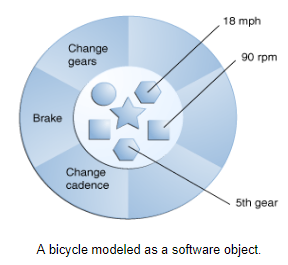
An object used in OODBMSs must have a set of attributes and methods. Attributes are what define the characteristics of the object, and the methods define the object’s behavior and are what is called the procedures and functions used in SQL. This means that the object contains both the code and the data. These objects refer to real-world objects such as bicycles have attributes (current gear, current speed) and behaviors (changing gear, applying brakes). The figures included below illustrate this concept using both a general object as well as the bicycle example.


Object-Oriented vs. Relational
The major difference between OODBMSs and relational databases (RDBMSs) is the way that data is stored and related to each other. OODBMSs store complex data and relationships directly, rather than RDBMSs that map relational rows and columns. RDBMSs use tables that are “normalized” so that data is not repeated, and all tables use a primary key to identify the column. Relationships used to get data from RDBMSs tables can only use one-to-one or one-to-many relationships, many-to-many relationships require a separate join table. In other words, RDBMSs require a lot of time and effort to code. Since objects typically use a many-to-many relationship, this makes OODBMSs useful for large, complex data relationships. OODBMSs work very well in CAS applications (CAD, CASE, CAM), multimedia applications, projects that change over time, and in commerce applications.

OODBMSs have several advantages and disadvantages when compared to RDBMSs. OODBMSs are better than RDBMSs because (1) objects don’t require assembly and disassembly which saves coding time and execution time to assemble or disassemble objects, (2) there are less pages, (3) they are easier to navigate, (4) the hierarchy of objects can be locked, (5) this data model is based on the real model, and (6) less code is required when applications are object oriented. However, the disadvantages associated with OODBMSs are (1) this database is inefficient when the data and relationships are simple, (2) relational tables are simpler, (3) more user tools exist for RDBMS, (4) the standards for RDBMS are more stable, and (5) the support for RDBMS is more certain.

That being said, while OODBMS is a newer database system, I believe that this will eventually replace RDBMS especially when intelligent building technologies are becoming more and more common.

Sources

Comments
Sherry L,
I found your blog post on object oriented databases to be very informative and well written. As someone who has little experience with databases, I like how you explained what an object oriented database was by defining the main components of the database: objects. I did my post on this topic as well, and I also used the same graphic you did. I really like how it did a great job illustrating the concept of what an object is and how it is defined.

Kerry M,
Your post on relational database theory was very interesting! I also took the INFO 210 class, and I think you did a really good job describing what a database is. Knowing that most of our class hasn’t taken that class, your post was very clear and informative for people who don’t know anything about databases. With the emergence of Dynamo, I feel like relational databases would be used more and more in our field.

Thomas S,
I really liked your post on structured query language! I had to use SQL for my INFO 210 class and I think you did a great job explaining what SQL is. I agree with you that SQL allows us to be able to process any building data we may get from sensors and such. In the future, I think learning SQL would be beneficial to AE and CIVE majors to accommodate the growing number of intelligent buildings.

Thomas Sisson -Blog Post #5

SQL – What is it and why is it important?

          SQL – or Structured Query Language – is a very basic way to interact with elements in a database. It uses various standard commands such as Create, Insert, Delete, etc. to accomplish everything necessary to create and maintain a database. Many database programs use these standard commands, while some also add their own proprietary commands to the list. The basic nature of SQL is to provide a simple and easy to understand way to access database elements in order to limit the necessary skill to run the database. Before SQL, the interaction with a database was much more brute force, with what was called a Codasyl database. Let me preface this by saying that my experience with databases is very limited, and much of the inner workings of SQL and Codasyl are pretty foreign to me. How I understood it, however, is that with a Codasyl database, you needed to access each individual field that you wanted in order to extract that data that was needed. This becomes incredibly complex when there are many fields within the database, with the referenced article using a student list for a college course as an example. In this example, there was a “Courses” set, an “Enrollees” set, then list the student record from this set, and run a loop command to print out this list until there were no more names. If this means that it was simple loops and programming commands, then I can see the appeal of such a method, but I can also see how the difficulty of the method would limit the willing database operators. SQL appears to be much more relation based, and a single command could be used to achieve all of the individual steps listed above. This is incredibly important for when an industry needs quick and easy ways of pulling data from a database, since it limits working hours spent and improves productivity. The gap in difficulty between the two methods just becomes larger when more complexity and volume is added to the database. Instead of running individual commands to narrow down a search to one out of a hundred sets and then sorting it by whatever property, a database operator could just use a single SQL query using a couple commands and its done.


          SQL is important to us because it gives us a way to use the data that a building may generate for us. For construction, a database could contain different materials needed to complete a certain section of a building, during a certain phase, and order them by cost, date to be installed, or whatever needed. This data could either be used in a report, or could be then transferred to a program which could read it and automatically determine any inefficiencies, or begin ordering the materials, or even send this data to any autonomous fabricators to begin the construction. Post construction, all of the different systems could be outputting large volumes of data that a building controller could use to properly regulate the buildings temperature controls, façade elements, or any other system. It may even be used to detect potential problems in the building’s structure using vibrations, or cleanliness using air particle detection. SQL enables all of this since it will give the various controllers a way to interact with the database. Perhaps more efficient methods will come around and SQL will go the way of Codasyl, but for now it remains the most effective method.

Citations:

Heller, Martin. “What Is SQL? Structured Query Language Explained.” InfoWorld, InfoWorld, 28 Aug. 2017, www.infoworld.com/article/3219795/sql/what-is-sql-structured-query-language-explained.html.

SQLCourse. “What Is SQL?” SQLCourse - Lesson 1: What Is SQL?, IT Business Edge, 20 Aug. 2000, www.sqlcourse.com/intro.html.

Comments:
Sherry L:
Your post is very informative. I am struggling as well with some of these definitions, and had some significant trouble at the start of writing my blog post. The way you define an object is pretty clear, since it makes sense that everything is stored as an object, and that object would have its own set of definitions. What I still don't fully understand is the difference between object oriented databases and relational databases, as you mentioned. The way I think I understand it after your post is that one stores data with certain definitions that group them, while one has sets of definitions with individual objects stored in them. I may be misunderstanding this though, and hope we can have time to cover this in class.

Kerry M:
Thank you for this post, it was like a light-bulb turning on above my head. The source I had used was describing some database strategies using the term "one to many" and I had no idea what they were trying to say, but your topic cleared up what they mean in terms of a database. Between your post and Sherry's, I think I have a decent idea of these types of databases, although I am still a bit fuzzy on the differences between the two. The relational database does seem to drive the SQL model that I had looked into for my blog post, as every command is based on relationships and using them to narrow down the data that you want.

Zac A:
I appreciate how you covered some of the industry databases that we are likely to run into in our jobs. I had heard about P6, but never really realized it was run off of a database, but it makes sense in retrospect. Every activity is related to the other activities and has its own rules and restrictions that need to be kept under control. Your post has helped me to loosen my definition of a database a little bit, as before I pictured them to just be large excel or access spreadsheets full of numbers/data that could only really be interacted as such. The idea that a database can be used in more creative ways such as scheduling and file storage is really interesting and it makes sense that it is widely used in practice. This also bodes well for the use of databases in most intelligent building applications.