Showing posts with label Group A. Show all posts

Tuesday, March 13, 2018

Week 10 - Course Reflection - Nay Ye Oo

AE 510: Course Reflection


I came into this course with no knowledge about what the term Intelligent Building means at all. And I expected to learn more about what makes a building intelligent and how technology is applied in the field of civil, architectural and environmental engineering. As a BSMS student, I talked to some seniors about to complete the program and they recommended me to take this course because there were some principles and projects that would help out in future classes. Now that I have taken this course, I do see the value in the projects assigned in this class and how useful it is - database project.

I always liked excel and would use it as much as possible in any type of project during my Drexel life as a student and being exposed to Microsoft Access was an eye opener. I might not have been able to complete achieve a full understanding of the program's capability but now I can pick it up whenever I have the time to explore its full functionality better and be able to apply it in my future career.

My favorite parts of this class would be the lecturing videos that feature any type of innovative technology or application of it in the construction industry and the guest lecturers that Professor Mitchell brings to class. I always categorized the CAEE engineering as the most archaic type of engineering, at least when comparing to similar engineering branches such as computer, electrical and mechanical. Personally, the videos shown in class are a bit stretched out in the sense that using AI in construction is plausible but not efficient enough in terms of cost. But give or take a couple decades and we might just be seeing an actual impact of technological advances in construction. The more palpable improvement we can see is in the design phase. Software such as AutoCAD, Revit, Naviswork, Rhino, Grasshopper and more have all definitely made our lives as civil and architectural engineers easier and more efficient.

So to conclude, I am glad I took this class as my grad elective as it is an eye-opener for me to remind me that the engineering path I chose still has a lot of more room for development. It is just a matter of time and resources.


Comments

Johnson
Good point on talking about the applicability of this class in our future profession. I definitely got exposed to naviswork and software that are 'next-level' to that of Revit. And since I am planning to pursue a career in design, I think it is very helpful to have taken this class. For your final project, 3D laser scanning sounds like an interesting piece of niche knowledge to pick up on so I am glad this course was also helpful to you too.

Odorizzi
It seems that we picked up interesting and beneficial nuggets of information from this class. Databases was completely new to me so it was great to have another tool to add to our belts of engineering knowledge. Unfortunately, I did not have as much prior Revit experience to expand on that front. So kudos to being able to take the extra mile with the Revit project and even making your Final project about it. Hopefully I get to watch you present on Thursday.

Tufano
It is nice to be able to meet with fellow BSMS students in our undergraduate classes because it gives us a chance to work with 'like-minded' people. Also majority of the class is based on class discussions, online discussions and group work where everyone gets a chance to collaborate and discuss. I think this sense of non-traditional way of teaching really shines out compared to the more traditional approach of lecturing and listening because I get to work with a group of people who have such different ideas and opinions that the learning experience is exciting and informative.

B7 - Course Reflection, Odorizzi


AE 510 fostered discussion about the future and new technologies that I had not taken time to consider carefully before. It was refreshing to gain awareness of how new technologies are integrating into the construction industry and project how these developments will impact our future professions. I think it was useful to break down some of these developments at a fundamental level to help build our understanding of the topic, namely with BIM and databases. Having worked with Revit in the past, I was able to expand upon my previous knowledge of Revit through our family assignment, as well as by diving into depth with an interdisciplinary model for the term project. Databases were a topic I had never pursued in the past. I found the discussion of databases very interesting, and it was a useful tool to gain exposure to for future uses.

Another aspect of the course that I enjoyed were the blog posts. As annoying as they often are to complete, I enjoyed reading through other classmates’ posts and seeing their thoughts. Fo topics such as the introduction to databases, I found it a great way to compile information about the topic without reading in depth about each topic ourselves. The in-class blog posts that we did early in the term felt forced and I did not like those - but the weekly blog posts were enjoyable.

With regard to the course’s impact on my profession and future, it has definitely motivated me to investigate the technologies and software at the forefront of the industry. For example, Dynamo is in-built feature of Revit 2017 and I would be interested in spending some time exploring its capabilities. Other facets, such as impact detection software, would also be super interesting to learn. Gaining a knowledge of these niches may be advantageous in industry to set myself apart from other engineers, and would likely be a source of increased efficiency if I am able to gain proficiency in the software. AE 510 gave a very interesting overview of the concept of intelligent buildings and the technologies arising today to make these types of buildings possible.

Comment to Lauren Kujawa
I echo your comment that many of the topics and discussions we had in class were new to me - and I also enjoyed thinking about technology and aspects of intelligent buildings that I had never considered before. I would challenge your statements that both databases and sensors are not applicable to your career. Without knowing your concentration, I feel like databases and sensors have become integrated into our regular usage that we don’t recognize all of them. Perhaps you will not need to know the inner workings of the sensors like Professor Mitchell pushed us to explore, or need to craft a database from scratch, but I would be very surprised if your professional career was entirely void of databases and sensors.

Comment to Malik Anibaba
After reading your post, you made me think about “what did I expect of this course when I started,” and I think you articulate well that AE 510 encompassed a much broader scope with big-picture ideas that I was anticipating. I also discussed in my post the benefit of the blog posts to help the class collectively cover more content. I thought many of the topics we discussed were very interesting, and I agree that these discussions will help prepare us for the professional world.

Comment to Alyssia Deutsch
The classroom in the cadlab is ALWAYS cold - it’s absurd. I like how you discuss the blend between your technical knowledge and the real-life application of that knowledge that we discussed in AE 510. I think that is a key benefit to the course - it builds awareness of the technology being integrated into our profession. Now you know that you may need to read up on some AI applications for CMU design. I similarly felt that the course offers motivation to learn about these new software, like Dynamo, and continue to read and remain aware of the technologies associated with an Intelligent Building.


Monday, March 12, 2018

Tran_D - B7 - Course Reflection


At first, I would admit that learning BIM software was my mandatory purpose to register for AE-510. However, course material offered by this class has more topics than what I expected. Intelligent Building is a wonderful seminar about the current trend of AEC industry, and future technologies that would apply to this industry. Moreover, Professor Mitchell constructed this unique class content that would avoid the traditional method in learning course materials: quizzes, exams, and long lecture. In fact, the structure of the course as a combination of short lectures, group works, and self-study allowed me to explore a lot more about the certain topics.

The design-based project offered a great opportunity to learn and practice Revit software. It is an interesting project for me as this is my first chance in modeling structure system, and MEP system in Revit as I came to AE-510 before taking Architectural Engineering Design (AE-390 and AE-391. In fact, I could conclude that MEP system design was the most challenge tasks on Revit, and Plumbing design is the most complicated and annoyed part within a MEP system. Thus, I enjoyed modeling a building in Revit, and would agree that BIM software will be a standard in AEC industry. However, as I mentioned in my project presentation slide, interoperability with other design and/or analysis software within a project is recommended since Revit is a jack-of-all-trade, but master of none software in building sector. 

Guest lecturers from AEC industry makes this course wonderful, as they introduced many different ideas and current trends in the industry. In fact, guest lecturers from the industry offered a different viewpoint in Revit application and other software relates to BIM. Dynamo, introduced by a first BIM guest lecturer, will become a good supplemental programming software to benefit Revit, but will also offer a challenge to engineers on coding and programming. Moreover, virtual design and construction (VDC) is an evolution technology on construction management, which helps manage the project from the beginning to end. Navisworks is a great software in project control, which allows professionals to integrate and review models from different stakeholders. I wish I could use Navisworks in Senior Design to have a chance to evaluate my design abilities. Moreover, a guest lecture for database topic would make its more interesting than driedly theoretical definition, and the repetitive process in database assignment.

In conclusion, this is one of the best graduate-level courses in terms of professional development. Building sector is actually the career path that I would love to pursue even though I got Water sector firms on both Co-Op cycles through ranking. This course helped me understand the nature of Revit, and BIM in a wide picture. My last wish after finishing this course is to experience future technologies discussed in lectures and Evernote articles throughout ten weeks that will become a new standard on AEC industry.

Comments

To Cody Johnson: 

Cody,
I found that your final project is interesting, as how 3D laser scanning benefits to Building Information Modeling (BIM), and I hope I could experience about the technology that you will introduce. I believe that available technologies are changing daily with the advancement of computing devices and equipment, and that current technologies would be phased out after 10 years. You are right that we will become valuable for the industry by having a good knowledge on current technology trends. I wish you could success in contracting industry after graduate.

To Alyssia Deutsch:

Alyssia,
I have a good time reading your course reflection by the complaints about heating issues in our CAD Lab. I hope that the air conditioning in this room will work properly during Summer time. Also, I like your discussion about the integration of technology and engineering knowledge discussed in Intelligent Building, and how they are applied in a real-life project. I believe this is a biggest aspect of the course. Throughout my project, I also learn that while designing an architecture model, and a structure system for a typical building, we will have to leave some spaces for MEP system, and AI devices to monitor the building. 

To Dee Dee Strohl:

Dee Dee,
Professor Mitchell, and our guest lecturers who he invited for AE-410/510 are very knowledgeable, and have a solid experience in these topics discussed in this course. I also believe that our course is one of the most unique course offered in CAEE departments that briefly introduces current technologies in building sector, and leaves rooms for us to explore more in our career. Blog post is also a powerful tool in this class to communicate with classmates, and learn from their experiences about the certain topics of intelligent building. 

Thursday, March 8, 2018

Group A Week 9 Story Post - Teaching Hospital

Group A:
Mark Odorizzi, Sarina Tufano, Dung Tran, Nay Ye Oo (Sonny), Alyssia Deutsch, Kerry Milligan

The Prologue:
Discussion of the current hospital situation - and the shortcomings that will be solved by an intelligent building

This story begins at a run down teaching hospital named “The Rickety”. Every doctor, nurse, intern, patient and visitor have been slightly creeped out by the small corridors, the uneven temperature distribution and the lack of new technologies. The lights were always flickering, making anyone in their presence feel uncomfortable. Those systems that did work, made erie noises and thumped randomly at any given time, but highly prefered to do so in the dead of night. Since this building was constructed before codes had been renewed, not many rooms had significant means of egress or sufficient natural lighting which only added to the sinister aura the building gave off.

In an effort to correct all of the dilemmas faced by this building and its occupants, a team of an architect, engineers, project managers, maintenance crews and hospital personnel got together and made a list of all their individual needs:

“WE NEED MORE ROOM!” - Dr. Milligan shouted
“WE NEED SENSORS TO REGULATE THE AIR QUALITY” - Mech. Engineer
“WE NEED A DATABASE TO KEEP OUR RECORDS” - Medical Students
“WE NEED UTILITIES THAT DON’T BREAK EVERY DAY” - Maintenance Head
“WE NEED QUIETER HVAC!” - Surgeons
“WE NEED FASTER WIFI” - EVERYONE
“WE NEED MORE MOTION SENSORS” - Dr. Milligan requested
“WE NEED MORE VIDEO SURVEILLANCE” - Project Manager   
“WE NEED MORE EASE OF ACCESS” - Architect
“WE NEED MORE LIGHT!” - Owners
“WE NEED CHEAPER BILLS!” - Maintenance Head
The hospital employee stakeholders in this story are Dr Milligan (because he was living through the issues and has the most knowledge about what a better space would look like), the project manager (in order to handle all of the differing inputs from the stakeholders, Sarina is needed to represent the hospital as a whole and keep the project on track), and the maintenance officials (Dung is the one who deals with the hospital facilities on a daily basis, and has input on how to best design the new space with maintenance considerations in mind and deals with the creepy doctor who complains about everything).
The non-hospital employee stakeholders in this story include the engineers (Structural: Mark wants to make sure the hospital is structurally sound to handle the heavy equipment and unpredictable live loads), the code compliance consultants (Hospitals have intricate codes applied to them, so Sonny is here to make sure we stick to those codes and provide a safe and acceptable working environment) and the construction management team (Foreman Rizzi needs to make sure the construction does not interfere with existing hospital operations, while still being efficient and on time and budget).
The Fix:
Discussion of the steps taken towards developing an intelligent building and how the new technologies will benefit the occupants/stakeholders.

Many new technologies will be implemented in this hospital so that it can provide a better work and teaching environment. These include code analysis for design and renovation, many types of sensors for occupancy evaluations, a structural/MEP BIM model for programming and design processes, a building program database for better record keeping easier programming and occupational evaluations, as well as robotics for construction methods and acoustic analysis for renovational aids.

To better be able to ventilate and heat/cool the hospital, a new high efficiency HVAC system will be installed. Since many patients and doctors are easily lost track of within the hospital, motion sensors and camera equipment will be installed. Along with that, databases will assist in record keeping methods that are highly effective and user friendly. Additionally, rooms will be made slightly more spacious and more windows will be incorporated with additions being rendered through BIM and all of its associating counterparts within the new model’s operation and functions. This will cause the hospital to become much more efficient in its teaching methods, which will gain it more patients and result in more money which can pay for the best hospital equipment and doctors to keep teaching new interns. Overall, the stakeholders will get large payoffs over the years following this renovation, the patients will become much more comfortable, and the hospital employees will be provided with a much better environment in which to work on a daily basis. In the end, this hospital will also have a much more pleasant facade and no longer be considered the creepy hospital it was once known for.   


Tuesday, February 13, 2018

Blog Post 5 Sarina Tufano

"A relational database is a collection of data items organized as a set of formally-described tables from which data can be accessed or reassembled in many different ways without having to reorganize the database tables. The relational database was invented by E. F. Codd at IBM in 1970." [1] A relational database organizes data for classical and fuzzy databases. The term fuzzy database is used quite often throughout the text and is described to manage incomplete database information. This differs from a regular database that has clear data and information that it is working with. In any case, a relational database can deal with both frameworks to organize the data. It organizes using a series of algebraic equations. The algebra consists of a series of if statements and binary relationships that help the database flow. Functions can come out in a bunch of way consisting on univalent, total, injective and surjective. Depending on the outcome, the database is organized differently. Complex algebra like linear algebra with 4 by 5 matrices are used to assume the order of the organizing elements. The term dekind category is used a lot throughout the text and to some extent means how the code goes about solving the algebraic framework of the code. Arrow categories are introduced as the basis to the relational database The more I read into this article the more it reminds me of coding with MatLab. There are a lot of transpose matrices and abstract notation that is defined in order for the relational database to organize the fuzzy or classical database. Below is a figure of one of the very large and complex matrices that are used throughout this database organization method of relational database. It is very complicated how the code works and that is one of the reasons that I am being quite vague with explaining how it functions. [2]


Sources:

[1] Rouse, Margaret. “Relational Database.” TechTarget, SearchSQLServer, Apr. 2006, searchsqlserver.techtarget.com/definition/relational-database.

[2] Winter, Michael. “Dependencies in Relational Models of Databases.” ScienceDirect, Journal of Logical and Algebraic Methods in Programming, Aug. 2016, www.sciencedirect.com/science/article/pii/S2352220815001522.


Comments:
Wicker
After reading your blog post on structured query language, I realize that our topics are related to each other. I did not read anything about SQL in my articles so I am thinking how much of an integral part of relational database theory. Good summary of the YouTube video you watched. It is easier for the reader to understand when a video or a picture is involved.

Tran
I had no clue what object-oriented database meant and so reading your blog post was very informative. There was a lot of abbreviations and database jargon used but my takeaway is that it is an evolved version of the traditional RDBs. During my readings, I came across some articles that emphasized on the future of RDBs that would store more complex data. And after reading your post, I can see how OODB is the 'evolved' version of RDB.


Dee Dee
Great post. I would assume too that database in design offices revolve around information about clients, projects, product specifications. And this is without a doubt helpful for owners, project managers and design firms to all view and coordinate at the same time.


Week 6: Blog Post 5 - Relational Database Theory

Relational Database Theory


Definition

A relational database (RDB) is defined as a collection of multiple data sets stored and organized as items in a set of formally described tables (rows & columns). This data can be accessed or reassembled in any customizable way at a later point in time. This neat piece of creation was invented by Edgar F. Codd at IBM 1970 [1]. RDB runs on Structured Query Language (SQL), an application that provides a user-friendly programming interface for database interaction. [2] 


Types of RDBs
In an RDB, data is stored in a tabular format with rows and columns. A row represents a data instance and a column represents a column. One or more data that is stored relates to one or more data records to form functional dependencies. There are four types of dependencies:


  • One to One: One table record relates to another record in another table.
  • One to Many: One table record relates to many records in another table.
  • Many to One: More than one table record relates to another table record.

  • Many to Many: More than one table record relates to more than one record in another table. [2]
Function

The main capabilities of an RDB is its ability to communicate and relate one data instance stored in any row, any column, any table and any data set to another data instance in a likewise manner. The basic database operations are select, project and join. "Select" retrieves data, "project" identifies data characteristics and "join" combines relations of data instances.[2]

Other advantages include scalability and data security. It is basically a useful tool similar to Microsoft Excel, except instead of having computational power, it only stores data but can be store an enormous amount of data/information. Data security capabilities provide certain users access to all datasets while giving the option of preventing some users to access only certain databases. 

[1] http://searchsqlserver.techtarget.com/definition/relational-database

[2] https://www.techopedia.com/definition/1234/relational-database-rdb


Comments:

Mark:

I read your article as a way to compare the content we found since we have the same topic. Essentially, we cover the same content such as keywords in the definition of a database, the importance of relations. Great job on including the figures as it highlights and exemplifies the difference between tables with relations and one without.

Tyler:

My blog post covered the topic of Relational Database Theory which is basically the body of data storing. But while reading I saw that SQL is the main "language" used when talking to these databases we created. And your article reinforced my initially understanding of what SQL does. The highlight of your article to me is that SQL is still used as the main language used to talk to databases which I would assume technology nowadays would have probably have replaced it. But I like your idea (more so a statement) that SQL is and should co-evolve with databases and its various types. Not just simple inventory tables but complex large scale data such as AutoCAD and Revit related data per family created.


Chris:

I agree that time is money and money is time in the world of construction. this DSM sounds like a pretty neat piece of technology that could potentially revolutionize future construction work. Hours vs Months is quite a feat to achieve but what I would be worried is the socio and economical problems that will arise when "machines start stealing human's jobs".


Monday, February 12, 2018

Relational Database Theory - Deutsch - B5

Before diving directly into what "Relational Database Theory" is I think it is first important to fully comprehend how a database is defined, along with how Big Data is defined. 

In general, a database can be defined as any collection or storage of information that is valuable, organized, searchable and applicable. In other words, it allows for management of files and their records which can be searched, grouped, rearranged and cross-referenced to facilitate easy retrieval for its users. Databases can be organized in any number of ways that are most applicable for what is being structured. A new technique that is being used more commonly as of late, is combining separate databases into larger entities which are now defined as "data warehouses". This is done mostly to help assist in pattern recognition which just reinforces how important databases and data sources are. 

Next, there is Big Data. According to Cringely, "Big Data" can be defined as "the accumulation and analysis of information to extract meaning." Even though this definition is quite broad, I like how far it allows us to delve into how much data we use and rely on without even knowing or realizing that we do so. I feel as though Big Data is similar to the "data warehouses" I mentioned earlier. In the past, storage of data and the capability to analyze that data was expensive and not done as often. Ever since individual computers became a normalized thing, data collection and storage has become much easier and cheaper to keep records of. Big Data is important because it aids in predicting events, the safety of groups or individuals, problem solving and connecting seemingly unrelated events that would have never otherwise been noticed. 

BIM is similar to Big Data and data warehouses in the way that it is also its own "environment". What I mean is that we treat it like data warehouses when we combine separate Autodesk programs in order to complete a project and use them as cross references, as our guest speaker last week, Derek, had mentioned he does often. It is also used as Big Data in the way that it keeps and stores all information in an organized and applicable way that allows its files to be easily accessed and managed by all those who require it to do so. 

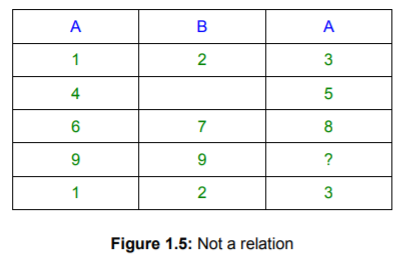
This takes me to Relational Database theory. As stated by Darwin "Relational database theory is built around the concept of a relation" which is meant to be taken from a mathematical standpoint so that any number of things can be more easily related. What is important to remember when thinking of this definition is that relationships between multiple characteristics or objects are relational and not exactly "equal to" and this can be shown most easily by using a table, or most specifically the tables given by Darwin himself:
This table does not depict a relation
This table does depict a relation

What is of utmost importance to note however, is that although the second picture does demonstrate relational data, it does not matter what order the columns and rows are shown in. This data in these tables shown can then be searched. When a this relational data is searched, it is called a "query". To output specific information, constraints dictated by the inputted "query statement" will be applied and this will produce the desired data. Microsoft makes a program named Access Database which allows you to set up your own relational tables and query it at the end. It can be done using any desired informational fields, whether large or small.
 Although I had never thought too much about databases until this term, this is now the second time I have come across it since we just used Microsoft Access in my AE T580 class to teach ourselves how to relate specific data we came up with ourselves in a simple way. As explained by Darwin the order in which we defined our relationships did not matter when we ran a query. Seeing this fact in action helped me understand relational database theory much better. 

Sources:

https://dvikan.no/ntnu-studentserver/kompendier/an-introduction-to-relational-database-theory.pdf

https://www.evernote.com/pub/aengineer/ae-510#st=p&n=b751f481-0f42-4f45-a51b-a77127a94351&t=ec0a31ef-f3b4-42b8-b58d-6ed4124da841

https://www.britannica.com/technology/database


Comments:

Dung Tran - 
I really like how you approach the main topic of relational databases by first defining databases in general. I did something similar in my post. I also think you did an exceptional job in explaining how the the math side of relational data, or the relational algebra, connects to the overall concept. I did not get the chance to check out Codd's research paper but it seems to be very helpful in understanding this broad and complicated theory.

Chris Thatch - 
I agree that databases are of utmost importance within the construction field, especially within the management aspect of things. I know that a lot more companies are making a bigger effort in going paperless in more recent years which would be very helpful when it comes to contributing to the databases already in existence. While this is more efficient, offices have found themselves actually using more paper. I wonder why this is, do you have any input? Also, could you define what RS Means is in a bit more detail? I have never heard of it but it seems to be quite important.

Jianfeng Xiao - 
Reading your post is very interesting. I like the examples you give that connect ways in which we use data readily available to us now through new technologies that make prior methods of achieving the same tasks obsolete. Data is such a useful tool when it comes to design because it allows for us to take what we know and apply it in smarter ways, hence smarter buildings and environments also! I will have to check out the articles you cited.


Dung Tran - B5 - Relational Database Theory

Building Information Modeling also involves interacting with databases stored within the BIM software. On Week 4, our guest lecture from Whiting-Turner mentioned that properties data of all components ranged from structure to MEP that organizes the entire project were tabulated to design and modify building components better. This process can develop a massive data sets, which working with parameters are strongly required to manage. Relational databases would benefit the work by grouping these regulated parameters of building components together. But, what is the relational database in the world?

Database

Before discussing about the theory of relational database, we should summarize about the definition of database. Britannica defines database as "an organized collection of data or information for rapid search and retrieval by a computer" [1]. Database was introduced in mid-1960s to replace the tape-based storage system, at which computers could capable of processing data from direct-access storage such as floppy disks. At that moment, the information within database was stored in a tab delimited file, which is a horizontally long, and unorganized text file. In fact, it was challenging to neglect the unnecessary information in a large database while organizing reports for only a specific field. Therefore, relational database was introduced in 1970 in E.F. Codd's research paper "Relational Completeness of Data Base Sublanguages" as a standard on database construction.

Relational Database Theory

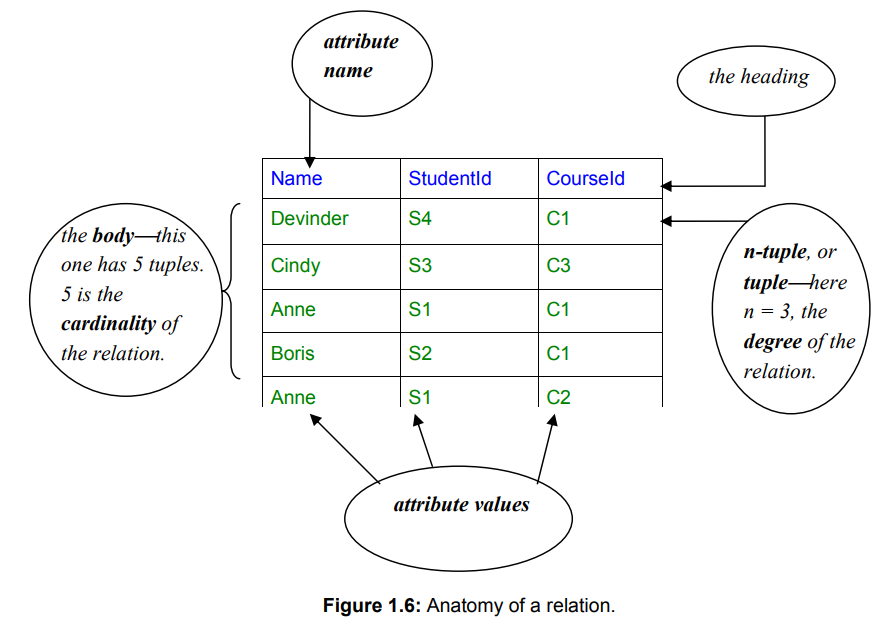
In his e-text "An Introduction to Relational Database Theory", Darwen defines relational database as a database set, which information was organized into a collection of relations in a tabular form [2]. Relation is a set of information that is associated with each other in algorithms, constraints, and more. Even though relation can be a table as stored in a tabular form, the term "table" is not completely defined relation. In fact, information stored in table can be free from any constraints or algorithms. Figure 1, on Darwen's e-text, demonstrates the comparison between tables that are either a relation or not. On the above table, raw information is organized in specific information such as Name, Student ID, and Course ID. For example, a student named "Anne", whose ID number is S1, registers for courses C1 and C2. 

Figure 1. Table depicting relational database (above), and not a relational database (below) [2]

According to Darwen, relational database theory includes the structure of a relation, relational algebra (mathematical theory that operates on relations), variables (set of parameters needed to operate the relational algebra), and constraints that regulate those associated variables [2]. A structure of a relation includes a table, whose columns represent its attribute, and rows represent tuples or the degree of the relation. Each row contains unique inputs, whose amount is respected to number of attributes (or degree). A complete dataset of the tuple is the combination of these unique inputs. A set of tuples generates a complete set of relation. Figure 2 represents the structure of a relation with their terms defined by E.F. Codd in his research paper. 

Figure 2. The anatomy of a relation [2]


Reference

[1] The Editors of Encyclopaedia Britannica. "Database" <https://www.britannica.com/technology/database>

[2] Darwen, Hugh (2010) An Introduction to Relational Database Theory, Bookboon.com.<https://dvikan.no/ntnu-studentserver/kompendier/an-introduction-to-relational-database-theory.pdf>

Comments

Milligan:

Kerry, this is a good introduction about relational database for someone who does not take INFO 210, or take a course in database management system. It looks like relational database has been a standard for constructing a data set for years, and most of our presentations involving with tabulated information uses relational database to present. Your examples are familiar about processing everyday data using relational database, which reduces the abstraction of theoretical discussion. Great work!

DiGiovanni

Brad, I am working on BIM project for this class which recreates a glass house built 80 years ago as a Revit model. It would be great if a general database is available for the building so that I do not have to skim through 20ish technical drawings to look for material components. Revit is also a great help by storing these information of a respective component. You are a right to mention about the importance of historical data of previous projects for design firms. It is essential for any design firms to be competitive by keeping records for maintenance, and case studies. In short, I believe 'Glass House' did not become a trend based on the data report about its vulnerability with outside environment / weather.

Liu:

Xiaoyu, I have struggles on my blog post about relational databases as well, and I hope we could be covered after the end of lectures on Tuesday. Your post is very informative about the definition object-oriented databases which is distinct from a tabular-based databases such as relational database. I believe an example of object-oriented databases is material properties stored in a respective BIM component, as all of its attributes is under a large umbrella. It is also great by controlling permanent and temporary data, that is how different elements in a same Revit family can be created.  

Odorizzi - B5 Relational Database Theory

Relational Database theory was developed by E.F. Codd, detailed in his first publication in 1969. The simplest and most generic definition of relational databases that I found is as follows: “A persistent storage mechanism that enables you to both store data and optionally implement functionality.”

I am going to organize this post the way I approached my reading - by gradually building my understanding of what a database is, the terminology associated with a database, and how a relational database layers a large degree of functionality.

I started by gaining a sense of what is a database? A major source of the information I’m going to talk about came from an online textbook, “An Introduction to a Relational Database Theory” by Hugh Darwin (2010). Darwin defines a database as “an organized, machine-readable collection of symbols, to be interpreted as a true account of some enterprise. A database is machine-updatable too, and so must also be a collection of variables.” The symbols that Darwin refers to is what we would typically think of as data, which is classified by attributes that describe the data - which is how I interpret his statement about “a true account of some enterprise”

With regard to relational databases, I learned that an important distinction to clarify is the difference between a ‘table’ and a ‘relation,’ both of which look like your standard datatable. However, the distinction is that a ‘relation’ consists of data that is definitively associated with each other. In Figure 1.6 from Darwin’s book, the attribute values can be read across the relation like a sentence: “A student named Anne has a student ID of S1 and is registered for Course ID C1.” This sentence is intuitively derived by looking at the ‘relation.’ A ‘table’ on the other hand can be a ‘relation,’ but does not necessarily have any association between the entries, as can be seen in Figure 1.5 from Darwin’s book. A relational database is one that organizes data into a collection of relations.


Databases are maintained by Database Management Systems (DBMS), and relational databases are specifically maintained by Relational Database Management Systems (RDBMS). As a user, we interact with the RDBMS, not the database. The chain of operations involves a command being generated from a application program and the RDBMS responding to the commands. This could involve executions such as alterations to the database (create, destroy, update, or constrain variables) or the supply of queries (results from the database). RDBMSs are typically operated on a server such that multiple concurrent users can be supported.

The power of relational databases becomes evident when behavior is established between the attributes of the database. At the simplest level, RDBMS can be used for storage, retrieval, deletion, security, and integrity of data within a database. This can quickly expand in complexity as numerous relations can be linked together to invoke specific procedures for storing data entries within the database, processing the data, etc.

I know I’m only skimming the surface of relational database theory and its capacity, but I think this gives a general overview of the potential and workings of a relational database.

Citations:

Darwin, Hugh. “An Introduction to Relational Database Theory.” booboon.com.  2010.

“Relational Databases 101: Looking at the Whole Picture.”  Agiledata.org.  2018.

Comments:

To Sarah Hollis:
Having only just heard of SQL in passing in my reading for this post, thank you for giving a nice overview! I had heard of VBA coding in Excel - but I did not realize that SQL was a language used majorly by Microsoft. It sounds like SQL is immensely powerful as a consequence of its key commands that you listed. I wonder what the equivalent code would require if java or c++ would be used instead. I do not have any experience in any of these languages - but if SQL is backed by ANSI and is standardized, it must have significantly more power.

To Zac Arnold
Nice use of your personal experience to offer some insights into database usage in the industry. I know on my co-op, there was one job that I was on CA for where we would use dropbox as a tool to share files between subcontractors, but the official submittals for shop drawings would be processed through Newforma. You talked about a lot of databases that I have previously had no exposure to. It seems remarkable to catalog and schedule out every activity of a construction project, but makes complete sense from an efficiency standpoint. The ability to access real-time data in the field through CMiC also seems immensely powerful. The flow of information into and out of that database must be extremely complex!

To Sherry Xiaoyu Liu
Great post! This was very informative and broke down the concepts of Object Oriented Databases very fundamentally. I had a post on relational databases, so it was interested to mark the differences in their structures. I would be interested to see the applications that use Object Oriented Databases. From your last statement, databases such as University course registration databases (transactional data) would be better suited for relational databases. I still don’t have a sense of which applications would be best suited for object oriented databases. Regardless, I think the object structure is very interesting. Breaking down the classification of every object into state and behavior are two very large umbrellas to cover all of the attributes of an object.


Sunday, February 11, 2018

Milligan - Blog Post 5

B5: Relational Database Theory
Relational databases are something many of us learned about in our first database management class – INFO 210. To understand relational database theory, it is important to first understand what a database is. A database is a collection of organized information, or data, all related to a central idea or topic. Digital databases hold this information digitally, either on a hard drive or in cloud storage. 

A relational database is a type of digital database. The relational database is based on the relational model of data. The relational model of data is centered around the idea of tables. There are a set of tables, each of which has its own category, containing the data that makes up the database. The data is organized into rows (tuples) and columns (attributes). Each row is one instance of data, containing information about each attribute relative to that data line. Each row contains a unique identifier, or key, to identify it from the other rows. Relational databases are easy to reorganize and enter or delete data from due to their structured nature. The central idea in relational databases is that these separate tables are connected, or related, in specific ways via keys or constraints. The related set of tables come together to create the database. 

Tables can be related in several ways. Two tables can have a one to one, one to many, or many to many relationship between them. In a one to one relationship, the primary key of each unique tuple appears in each table exactly once. An example of this would be a table with information about a student and a table with information about their university ID card. Each student has only one university ID card, and each university ID card is issued to only one student. In a one to many relationship, a primary key exists only once in one table, and potentially many times in the second table. An example of this would be a table with information about a student and a table with information about college departments. Each student is only a part of one department, but a department can potentially have many students within it. In a many to many relationship, a primary key can appear potentially many times in both tables. An example of this would be a table with information about students and a table with information about clubs. A student can be part of potentially many clubs, and a club can have potentially many students as part of it. In this case, it is best to create an intermediate table between the two to eliminate the complex many to many relationship.

The structured query language (SQL) is based on relational database theory. This language is used for all querying and maintenance of the relational database. A query is a request for information from the database. The results returned from the query show a subset of all of the data within the database that fits within the constraints applied in the query statement. 

Sources

Comments
Sarah: I used SQL in one of my database classes, but I didn't know some of the things you discussed in your post! For example, I didn't know that SQL was unique in that it is able to access more than one data file with one command. One thing you note is that SQL is relatively easy to learn due to its few and simple commands, and I definitely agree with that. It was a really easy language to learn, it was really intuitive. This makes it accessible to many people, and improves people's understanding of databases.

Zac: Your take of storage and sharing systems as databases was an interesting one. These types of systems are not something I would have considered a database, but I suppose as compared to the definition you provide from Wikipedia that they can be considered a type of database. These systems are absolutely a necessity in the construction industry, specifically in estimating and project management as you mentioned. I think your example of a scheduling database is a really great one. Specifically thinking of it in terms of a relational database, each activity can have information related to its specific instance in the schedule, as well as information related to it as an activity in general. 

Sherry: As I was reading your first paragraph I came to the same conclusion as you - it is quite difficult to understand the difference between object oriented databases and relational databases when I'm not even sure I know what an "object" is. After reading your post, I'm still a little fuzzy about what exactly an object is, but I understand much more than before reading! I think one of the difficulties in understanding object oriented databases is that, compared to relational databases, they are a lot less intuitive. We use tables all the time, and understand how to fill data into a table in a meaningful way. Without that concrete structure, objects are a little more difficult to understand.

Tuesday, February 6, 2018

Building Type & Intelligence (Deutsch & Tufano)


I am working with Sarina Tufano on this term project and our topic is Building Type and Intelligence. We have opted for the research paper version of this assignment and since we are both structural concentration we have taken "type" to mean materials and structural aspects. To do this we are picking to work with a single family home and design it with the newest smart and green techniques available and adequately researched thus far. The house will not only have smart qualities but will incorporate these starting at the structures very core. It is known that scientists keep developing better and more effective versions of the common materials used in construction. These will be used within the small family home to help keep the structure more self sustaining, extend its life cycle estimate and decrease its impact on the environment while also making it more user friendly.

When it comes to smart and green methods, the terms are sometimes used interchangeably even though they are somewhat different. While discussing the smart materials to be used in the structural design of this home, there will be tables/graphs/figures demonstrating which are just to be considered "smart" which are to be considered "green" and which properties might overlap within those two categories. The structure will take advantage of smart/green facade designs, smart steel/concrete, smart sealant techniques and produce much if not all of its own energy so that it may become LEED, Green Globe, or Live Building Challenge certified as well. It will source other materials needed locally, make an effort to reuse materials that were unused at its previous locations, and attempt maintain little to no waste outputs.

While the International Building Code clarifies different categories of building per "type", we are aiming to take the family home to the next level of what is mandatory in its structural design components. To do this much research will be conducted and definitions of what green and smart mean within a building and how it relates to the overall intelligence will be discussed as well. To demonstrate the materials used, models will be created if time allows. Costs will not be assessed since the main objective of this report is the creation of an optimized intelligent and green structure. However, this does not mean that the efforts to use the best and most "intelligent" materials will not pay out over the first few years of the building's existence. In order to make the building type as smart as possible the structure will maintain manageability so that as technologies improve, the building can also improve.

Jianfeng Xiao:
I notice that our topics are very similar. I like how you have emphasized that you are going to use newer buildings in your assessment since we know how fast technologies have been evolving recently. I am curious to see how you distinguish properties as either "smart" or "green" and which properties you might consider to fall under both classifications.

Sarah Hollis:
I find the history of BIM to be a really interesting topic. I think that reading about how its history has made it become what it is now will definitely lend you a hand in predicting what might be to come in the future. I see that you say BIM allows for fluidity but are you worried that if it becomes too renound and user friendly that people in some fields may lose jobs due to being replaced by any of the programs included in a "BIM Environment"? If you do, which do you think they might be?

Chris Thatch:
Intelligent appliances are such an integral part of what can help make a building more user adaptive and intelligent. I really like how you are going to research and see how many smart versions of appliances are available on the market today because I feel as though much of society is not adequately taught when it comes to better environmental practices. Even with the addition of so many improved products on the market now, many people assume that making a more intelligent or green building will cost so much more and isn't worth it. Little do they know that the returns can start in as little as one year! Your topic is such a good representation of this.


Week 5 - Final Project Term Paper Abstract - Definition of Intelligent Building

Blog Post - Week 5: Describe your project - (e.g. why chosen)

My topic for the final term is 'Definition of Intelligent Buildings' My initial idea for choosing this topic was inspired by Professor Mitchell's lecture on how the term Intelligent Building is still a vague concept. Below is an excerpt of what I initially wrote before writing my outline.


"After hearing your definition of IB and writing that discussion post, I finally understood that this is a relatively new term whose definition is still not cemented. The objective is to explore and analyze what is an intelligent building, from the perspectives of different people (definition varies with background knowledge, geography and technology) Classify the common components from the various sources and ideally, come up with the best definition of an IB that would hopefully be a standard definition."

After giving some thought into this topic, I am glad that there hasn't been anyone who chose a topic similar to mine. My only worry was not having enough sources to write a whole paper on this topic. However, I found a few websites and sources that addresses my topic and defines their own opinion/idea of Intelligent Buildings. Moreover, I can resort to learning from what my fellow classmates think based on their interpretation of the term after hearing Professor Mitchell's definition. I am hoping that the different background of each students major will give a diverse interpretation of the term and hopefully, I will be able to read all the different responses and filter out the common or recurring themes/features/components.

My next task is to analyze all these answers and compile a concise and accurate definition of the term Intelligent Building and hope for that best that everyone can agree on. Since I am working on this project alone, if there is any idea or topic that would help my paper be more comprehensive, I would appreciate any type of tips or suggestions in the comment section. Thank you.

Comments:

Luci,

 "an intelligent building focuses more on creating an environment that is comfortable and equipped with technologies that simplify redundant tasks as well as improving operation of facilities by providing feedback on systems"


I read your article in the hopes to learn what and how you define intelligent buildings out of curiosity. It seems that the main takeaway from your definition is the ability of a building to provide optimal levels of comfort. I would deduce that as an AE background, comfort is what matters most but this is just an assumption on my part. As for the rest of the post, I think you did a great job defining and contrasting your initial idea of green and intelligent buildings.

Carlos,

I love your topic. More so because I believe that it is very applicable. Coming from a basically a developing country, I can definitely see how this is applicable and important. I do worry that there is too much information to cover within the scope of your topic. So I would like to suggest narrowing to one or two topics just like you did with the case study examples and elaborate on it. Great job!

Malik,

I love your attitude on being open-minded to this topic. To be honest, I am trying to grasp if you defined intelligent buildings to help gather data about my project topic. But I love your idea of mashing both an intelligent and green buildings into one. Because why not? But yes, that is going to become a whole different topic from intelligent vs green and more of defining what an intelligent building is, a green building is and combining the fundamentals of both building components that make it what it is, into a wholesome entity.